
CardFax Research · Field Report
One Corner, Four Witnesses
How AI card grading caught a damaged corner on a 2025 Bruce Smith Prizm Black /175
One corner, on the black back of a numbered Bruce Smith, was read by four independent layers that did not agree. The examiner overstated the damage, the classifier missed it, the reference library stayed silent, and the geometry measured exactly what was there. This report shows how those readings became one grade, and why that grade is a 7.
Section · 01
The card
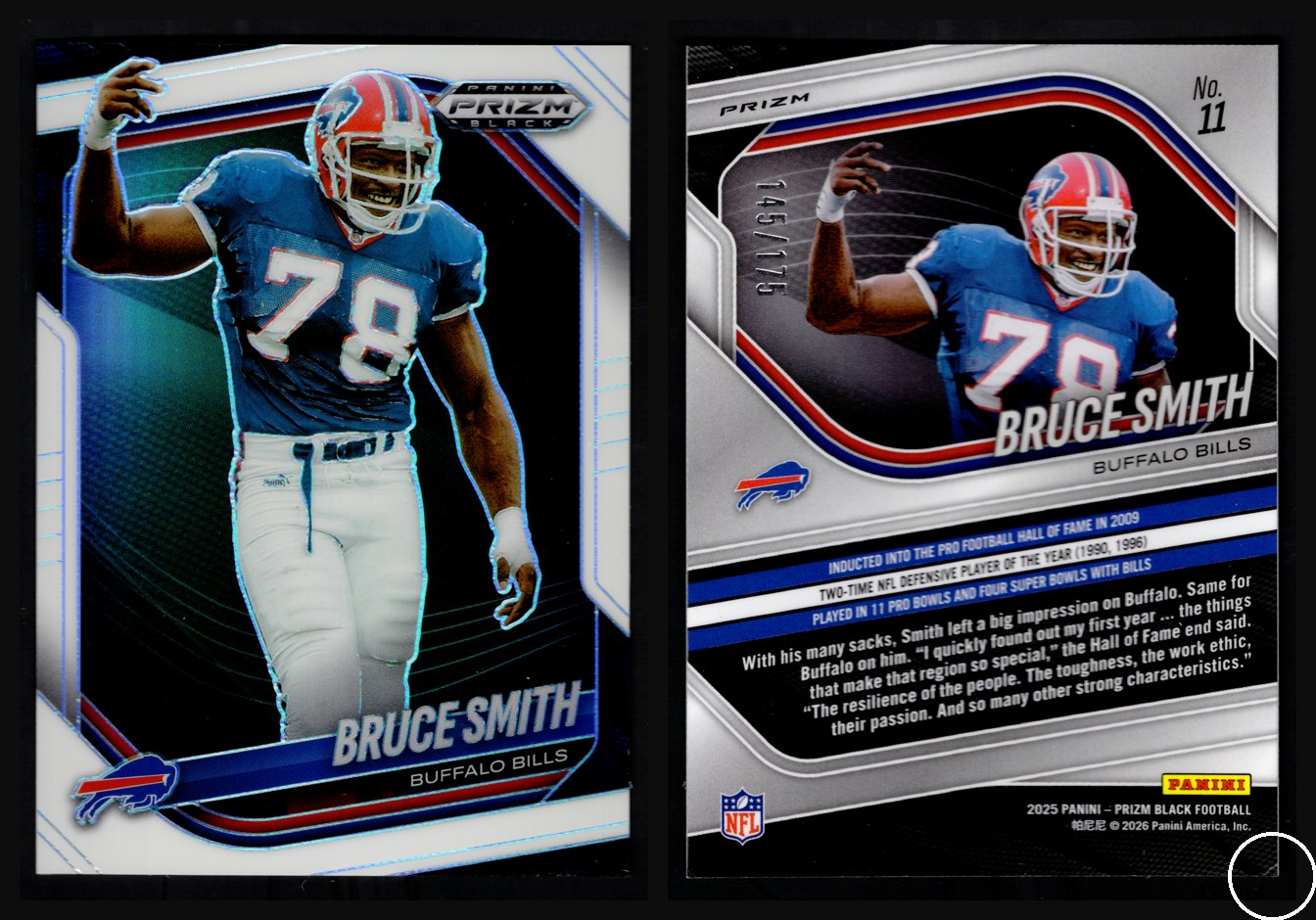
Bruce Smith is the NFL's career sack leader with 200, a Hall of Fame defensive end inducted in 2009, a two-time Defensive Player of the Year (1990, 1996), an 11-time Pro Bowler, and the anchor of four straight Buffalo Bills Super Bowl teams. This card is #11 in 2025 Panini Prizm Black, a White Prizm parallel serial-numbered 145 of 175.
Prizm Black is a premium chromium product, and its backs are what make it a hard card to grade from a scan: the bottom third of the back is printed solid black right to the cut. A scanner lid is black too. Where black stock meets a black bed, a corner's edge can be hard to tell from the background behind it, for a person reading the scan and for software measuring it.
Graded October 1, 2026: centering 10, edges 9.8, surface 9.3. Six corners read between 9.2 and 9.8 and the back bottom-left 8.5. The eighth corner decided the card.
Section · 02
The corner
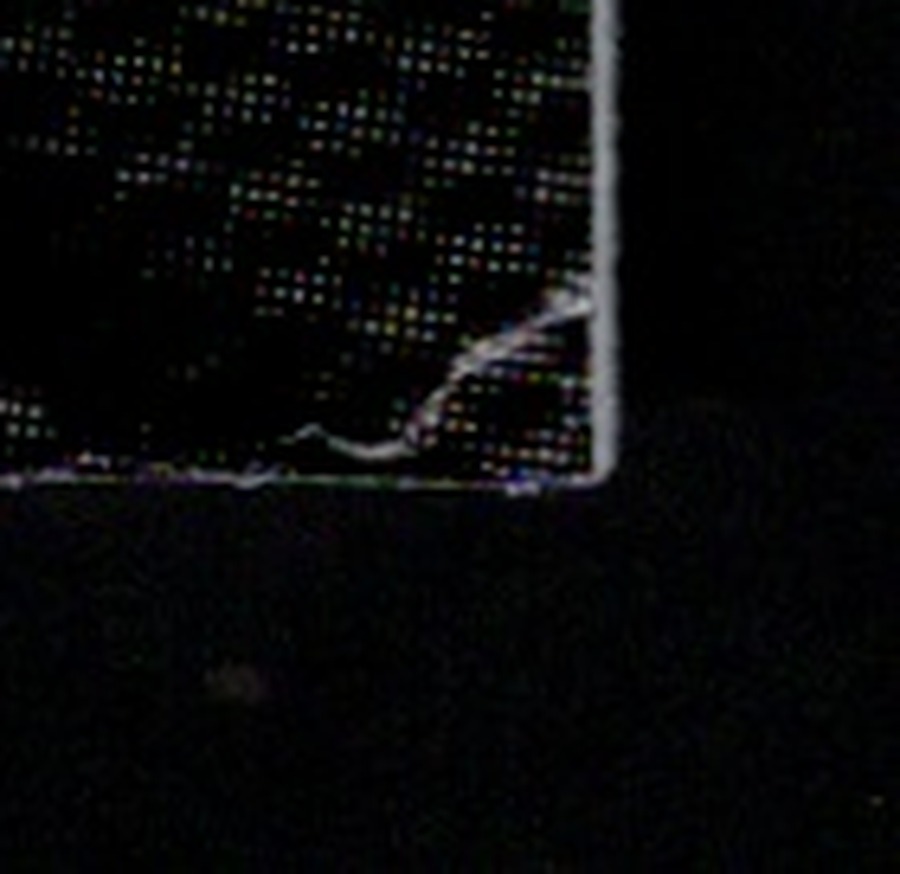
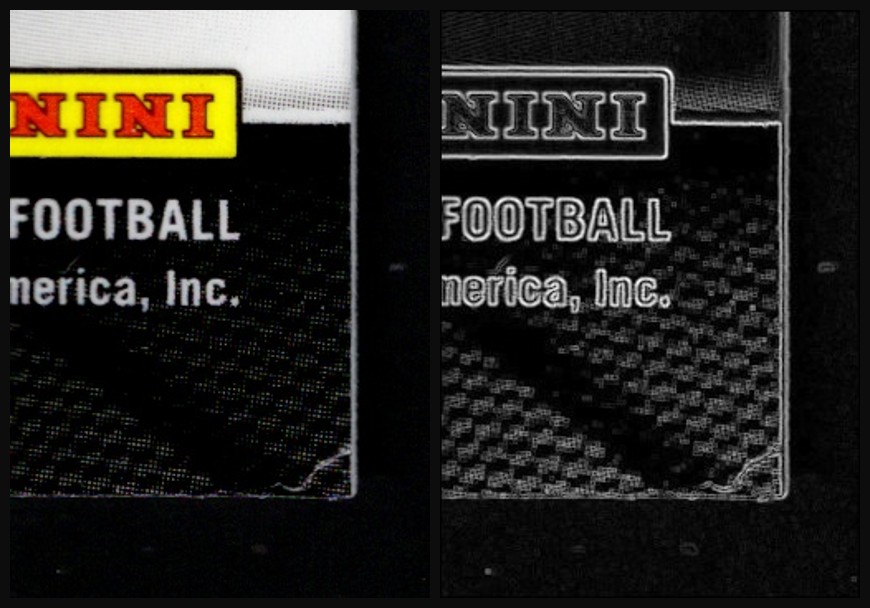
At the back bottom-right, the black surface layer is torn. A curved white line runs in from the bottom edge and up toward the side, where the printed layer has lifted and the pale stock underneath shows through. The tip itself has not been crushed or rounded away; the damage is the tear across it.
Section · 03
Four witnesses
Every corner is read by independent layers before any grade is issued. On this corner they disagreed, and each disagreement has a cause:
| Layer | Read | What it saw |
|---|---|---|
| Examiner | 5.0 | Read heavy rounding, heavy whitening and exposed fibers. It saw the damage and overstated the shape of it. |
| Detection model | 9.1 | Classified the corner in its mint band. A young classifier trained mostly on clean corners: it votes, it does not decide. |
| Reference library | No match | No reference corner was close enough to vote. Silence, not disagreement. |
| Outline geometry | Measured | Tip angle 87.9°, recession 2.0%, outline roughness 16.3 px. The tip is not heavily rounded; the outline is torn. |
Blended, these readings landed at 6.4, a number no layer actually measured. The engine does not average its way to a grade. A structural claim, such as heavy rounding, has to be either confirmed or refuted by measurement.
Section · 04
The measurement
The outline layer traces the corner's physical edge in pixels, from the card's own crop:
| Measure | Value | Meaning |
|---|---|---|
| Tip angle | 87.9° | Near square. A heavily rounded tip cannot measure this close to 90°. |
| Tip recession | 2.0% | The tip has barely pulled back from where the edges meet. |
| Outline roughness | 16.3 px | A disturbed outline. Clean, square corners measured on other cards read 0.6 to 0.8 px. |
| Card visible in crop | 28% | Black stock on a black scan bed: most of the crop could not be told from the bed. |
| Missing-material reading | 39.9% → set aside | A reading the dark bed produces, not the card. Removed under MOSES 2.18; the raw value stays on the record. |
The tip angle and recession refute heavy rounding: the tip is still where a square corner's tip should be. So the examiner's shape claim was capped at minor rounding, its whitening and fiber findings stood, and the corner moved from 5 to 7.
The roughness says the outline is disturbed, not by how much. On black stock it runs high: this card's back bottom-left, graded 8.5 for light fraying, measured 18.3 px. Roughness kept the corner from being read as clean; the severity came from the magnified re-examination below. Measurement decided the shape, and the eye decided how bad.
Section · 05
The dark-stock rule, under test
The grading ran on MOSES 2.18, released the same night. 2.18 addresses a known failure on black stock: when little of a crop can be told from the bed, the outline's missing-material estimate reports card that is not missing. On other cards that phantom reading had confirmed false low grades on clean corners.
This card is the case such a rule has to survive. Only 28% of the crop read as card, and the missing-material reading came back at 39.9%. Under 2.18 that one reading was set aside. Nothing else was. The tip angle, recession and roughness stayed on the record, and so did the examiner's whitening and fiber findings, so the correction removed a false reading without removing the real damage. A rule that rescues clean corners only earns trust if a torn corner still grades torn, and this one did.
Section · 06
The confirmation
A corner this far below its neighbors is re-examined at magnification before the grade stands. The re-examination tested each claim against the 3x crop:
- Tip, minor rounding: confirmed. The two edges meet in a slight curve rather than a sharp point.
- Fibers, exposed: confirmed. Fibers visibly break the outline into the background.
- Whitening, heavy: confirmed. Irregular white crosses the bottom cut edge.
The corner stood at 7.
Section · 07
The grade
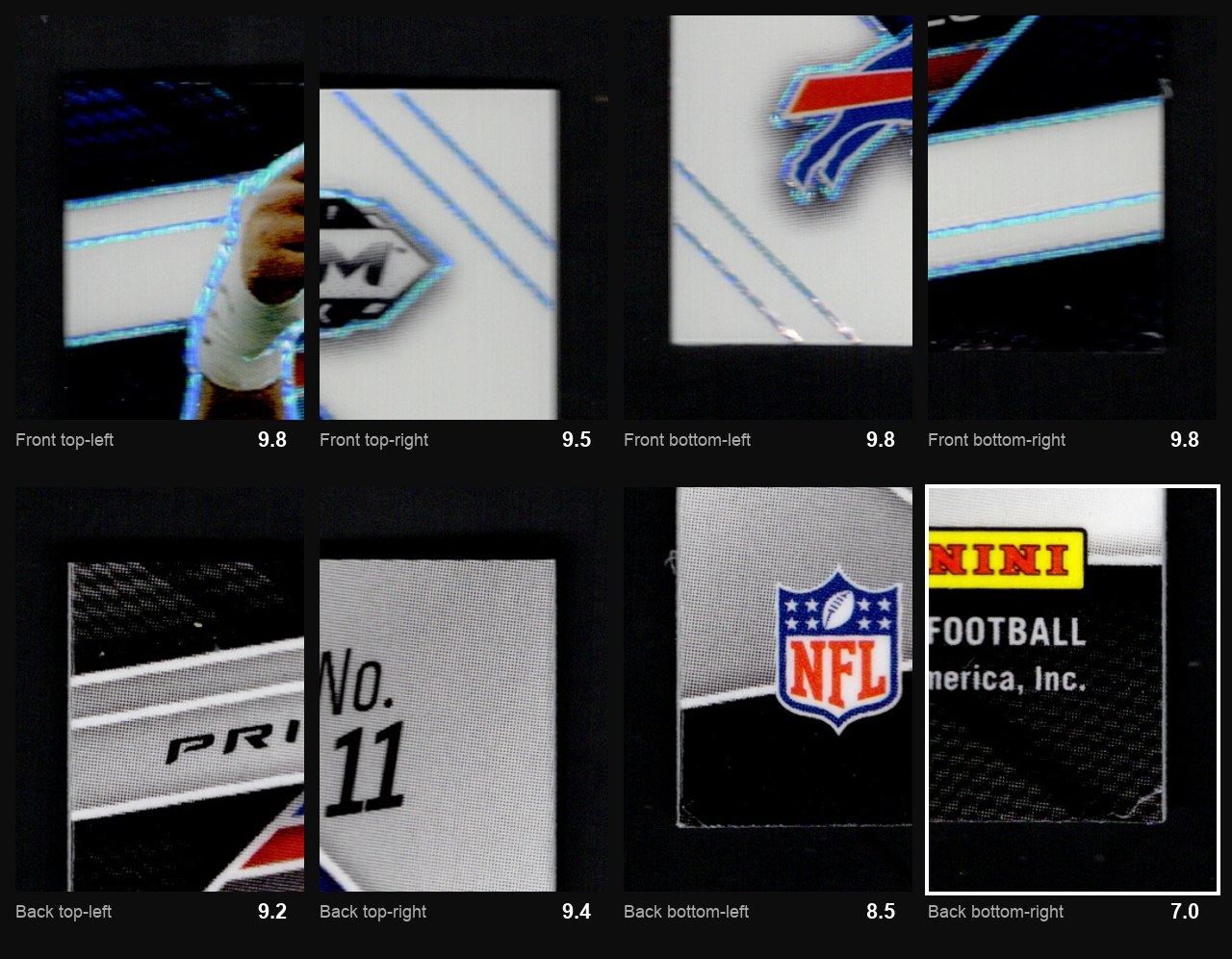
Under the published standard, the corners grade is capped by its weakest corner, and the overall grade by its weakest category. The other categories averaged above 9, with centering 10, edges 9.8 and surface 9.3. One torn corner holds the card at 7, and it should: the tear is the first thing a collector's eye finds when the card is turned over.
Section · 08
What it teaches
The detection model read this corner as a 9 because it has seen few damaged corners. It learns only from finalized cards, so once this card's record is final, this corner, a confirmed 7, measured and re-examined, becomes one of the examples it needs most. The card that tested the rule also teaches the model.
Frequently Asked Questions
Why did the corner grade a 7 and not a 5?
The examiner called the tip heavily rounded, but the measured outline put the tip within a few degrees of square with almost no recession. A heavily rounded tip cannot measure that way, so the shape claim was capped at minor rounding, while the whitening and fiber findings stood. A magnified re-examination confirmed the 7.
Why are black-backed cards harder to grade from a scan?
A scanner lid is black. When the card's own stock is black, the corner's edge and the bed behind it can read as the same thing, so a measurement can mistake card for background and report material missing that is still there.
Doesn't a dark-stock correction risk hiding real damage?
That is what this card tests. The correction sets aside one reading the dark bed corrupts, the missing-material estimate, and keeps every other measurement and finding. Here the torn outline and the whitening and fiber findings stayed on the record, and the corner still graded 7.
Does one bad corner lower the whole card?
Yes, by design. The corners grade is capped by its weakest corner, and the overall grade is capped by its weakest category. One torn corner on an otherwise strong card holds the card at 7.
CF-FR-2026-005 · v1.0 · Published October 1, 2026 · Model: MOSES 2.18 · Serial 8865716 · Registered on the CardFax