
The Blind Read
A browser tool that pregrades trading cards from marketplace listing photos was shown a professionally graded card — with the slab's label cropped out of existence before the analysis ever ran. It returned the same grade the label carries, and came within half a point of every printed subgrade. This is the record of that read.
Section · 01
The question
CardFax Pregrade is a browser extension that gives collectors a condition opinion on a card before they buy it — from nothing but the seller's listing photos. The obvious objection writes itself: photos are not scans, opinions are not grades, and a tool that peeks at a slab label isn't analyzing anything. So the tool was built to make the objection testable. The strongest test available: hand it a card that already carries a professional grade with printed subgrades, make the label physically invisible to the analysis, and compare.
Section · 02
The blindfold is architecture
The pregrade pipeline borrows its method from the CardFax grading engine. A first vision pass locates the card's outer edges inside the listing photo. The analysis then receives only what sits inside those edges — the card, cropped out of its surroundings. A slab's label is outside the card's edges, so it is outside the analysis: not ignored by instruction, but absent from the input. The four corners are additionally cut as close-up crops at the photo's native resolution and examined individually. Each of the four quadrants — centering, corners, edges, surface — receives its own estimate and its own confidence, and the overall grade is then derived from those quadrant estimates arithmetically, on the whole-grade Gem-Mint scale. No step of that chain can see, or be swayed by, a label.
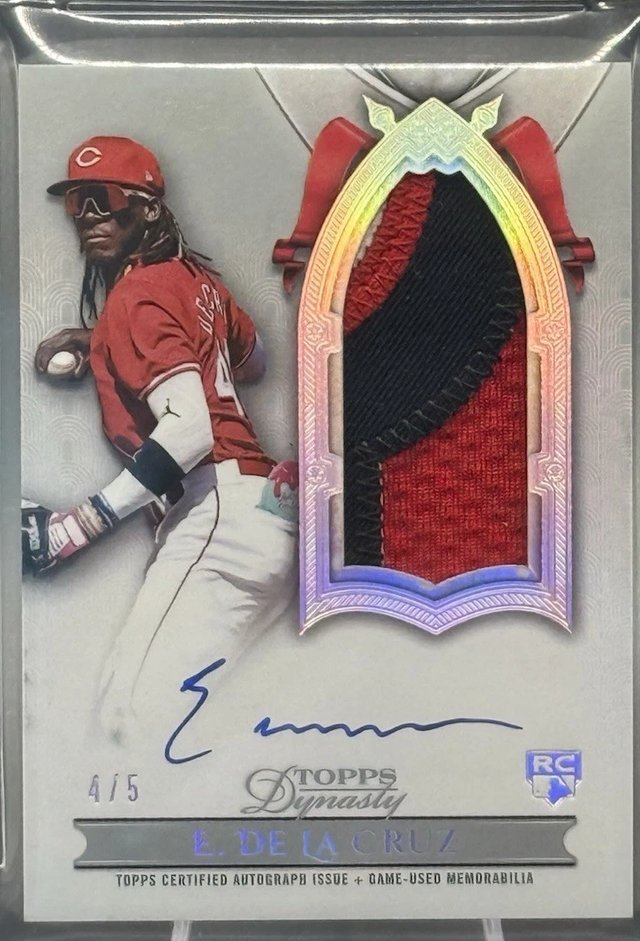
What the analysis received
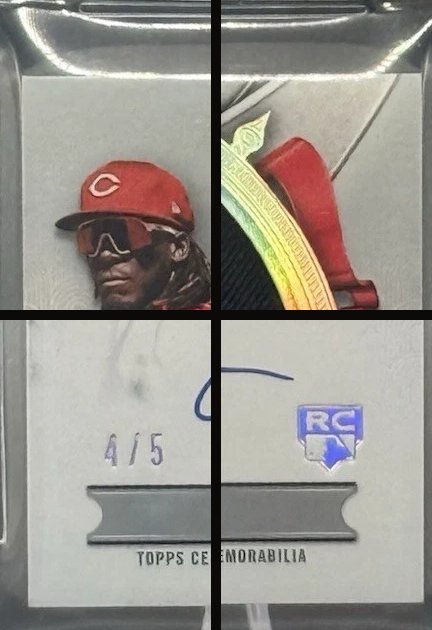
The corner close-ups it examined
Section · 03
The card
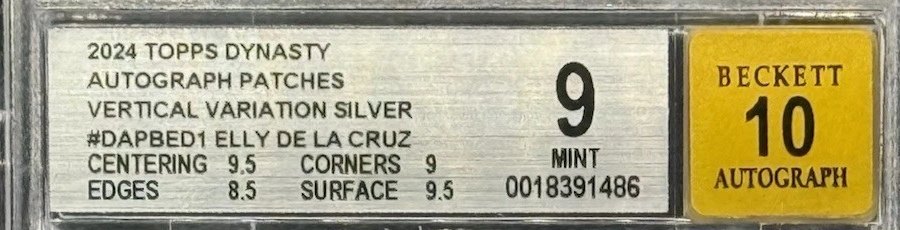
The subject: a 2024 Topps Dynasty Elly De La Cruz Autograph Patches card, serial numbered 4/5, listed for sale in an online marketplace. The card sits in the slab of an established grading company, graded Mint 9, with the company's own quadrant subgrades printed on the label: centering 9.5, corners 9, edges 8.5, surface 9.5. Professional graders published their answer key on the slab. The pregrade tool never saw it.
Section · 04
The results
From two listing photos — front and back — the blind pipeline returned a most-likely grade of 9 with quadrant estimates of its own. Side by side with the label it never saw:
| Quadrant | Label subgrade | Blind read | Agreement |
|---|---|---|---|
| Centering | 9.5 | 9 | within 0.5 |
| Corners | 9 | 8.5 | within 0.5 |
| Edges | 8.5 | 8.5 | exact |
| Surface | 9.5 | 9.5 | exact |
| Final grade | 9 | 9 | match |
Two quadrants exact. Two within half a point. The identical final grade — derived arithmetically from the tool's own quadrant estimates, not copied from anywhere, because there was nowhere to copy from. Professional graders held this card in their hands, under instruments, and printed a 9. Software looking at a seller's photos, blindfolded to their answer, agreed with them quadrant by quadrant.
Section · 05
Why the blindfold matters
Before the blindfold became architecture, it was an instruction: the analysis was told to disregard any label it could see. Testing exposed the difference. On a vintage card whose slab label displays a low grade, the label-visible read landed one grade lower than the label-blind read of the same photos. The label was exerting a measurable gravitational pull on the opinion — even under orders to ignore it. Anchoring is not a discipline problem; it is an input problem. So the input was removed. What remains is the only thing a pregrade should be: the card's own evidence.
Section · 06
What this is — and isn't
One card is a demonstration, not a study; validation continues across cards, eras, and photo conditions, and every pregrade is logged against later ground truth. A pregrade remains an opinion from listing photos — delivered as a range with a confidence level, never as a registered grade. Registered CardFax grades come from controlled scans on the CardFax engine, where the corners are measured in the tens of pixels and the cut lines are traced column by column. What this field report documents is narrower and still, we think, remarkable: the same method that grades cards on the engine — isolate, measure quadrant by quadrant, derive the grade by law — holds up when compressed into a browser tool reading a stranger's photographs, with the answer key stripped out of frame.
CF-FR-2026-002 · v1.0 · Published September 26, 2026 · Tool: CardFax Pregrade (Beta) · Card Grading Engine powered by MOSES